In What’s on Your Editing Bookshelf, members of the editing community share what’s on their (physical) bookshelves and highlight a few notable titles. In our eighth instalment, four editors from Toronto share some of their favourites. If you’d like to show us your bookshelf, let us know!

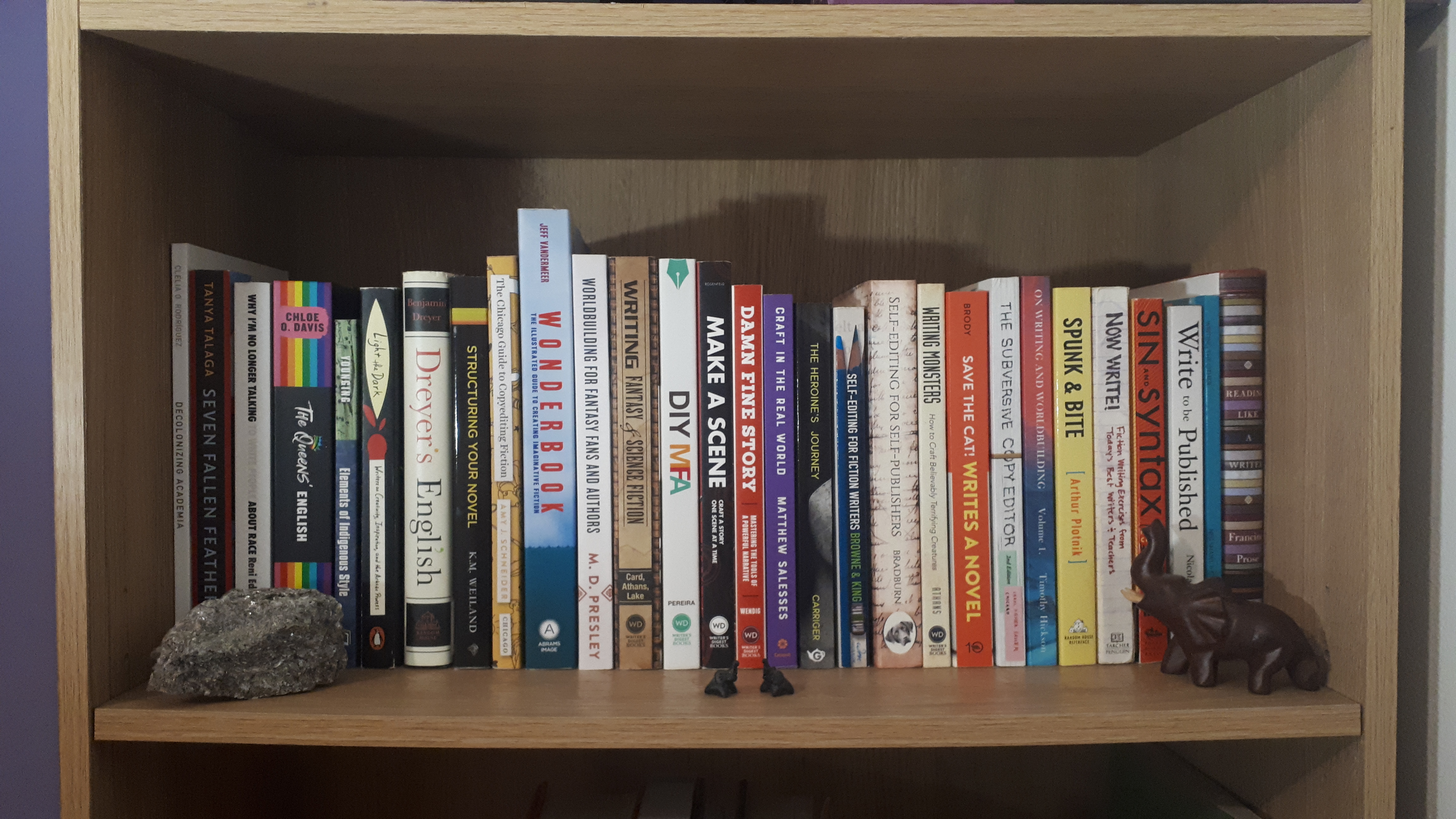
Genevieve Clovis is a novel editor and writer. Her bookshelf is in Toronto.
There are so many wonderful craft books out there, but sadly I cannot keep all of them on my shelves. I have one shelf for style guides, dictionaries, and other writing-adjacent reference books, and this lovely shelf for my editing and writing craft books. Here’s a little about three of my favourites from this shelf.
The Heroine’s Journey: For Writers, Readers, and Fans of Pop Culture, by Gail Carriger, is a phenomenal book. It illuminates a story structure that isn’t often spoken about or acknowledged in such concrete terms, even though many books written using the heroine’s journey are wildly popular and successful. I highly recommend this book for developmental editors in particular because the more structures we’re familiar with, the better able we are to advise our clients.
Wonderbook: The Illustrated Guide to Creating Imaginative Fiction, by Jeff VanderMeer, is a visual feast and is chock full of great tips and advice for editors and writers alike. There are a bunch of essay contributions from well-established authors throughout the book and writing exercises related to each of the sections. Excellent foundational knowledge aside, I really appreciate the focus on the more playful and creative side of writing that this book offers.
Damn Fine Story: Mastering the Tools of a Powerful Narrative, by Chuck Wendig, talks about story in a broader sense than most writing books. It focuses on engaging the audience with storytelling regardless of the delivery medium. So, while there is considerable overlap with novel writing specifically, much of the driving force of this book is how to make the audience care about the characters.
I know I said I’d share three favourites, but I also have to give a shout-out to The Queens’ English: The LGBTQIA+ Dictionary of Lingo and Colloquial Phrases, by Chloe O. Davis, because no dictionary has ever given me so much joy.
Anna Bendiy (she/her) is an editor, writer, translator, and content designer. Her bookshelf is in Toronto.

I read widely in the genres I edit and translate, so my craft books are chaotically wedged between fantasy, sci-fi, general fiction, history, and kidlit across multiple bookshelves.
I’ve read a lot of editing classics, but one I go back to more often than others is Practical Grammar: A Canadian Writer’s Resource, by Maxine Ruvinsky. Its easy-to-follow layout and examples make it perfect to reference a rule for a quick refresher or an inspiration for how to communicate an edit to a client. Otherwise, I live in the digital edition of The Chicago Manual of Style.
For content design, Strategic Writing for UX, by Torrey Podmajersky, is a great place to start, both for an overview of writing for tech and quick solutions to specific content problems.
I also love to read books on the craft of writing. As a fiction writer, I get to try a new strategy when I’m stuck, but they’re great tools for developmental editors, too. I often like to recommend good writing craft books to clients looking for next steps or as an extra example for specific substantive feedback I’m making in the editorial letter. These books also show me how writers talk about writing and self-editing with each other.
I’m currently enjoying The 5 Sentence Method: How to Write Your D*mn Book, Already, by Rebecca Thorne. It’s a “pantser’s” take on the three-act structure. It’s full of great examples for writers coming to terms with plotting their books. One book I desperately need to get to is Craft in the Real World: Rethinking Fiction Writing and Workshopping, by Matthew Salesses. As “word people,” it’s so important to continue to examine our biases about storytelling and craft — I can’t wait to see what Salesses has to say about that.
One gap in my collection are craft books on the art of translation . I’ll be on the lookout for those next!
Sharon Cozens is a freelance copy editor and writer. Her bookshelf is in Toronto.
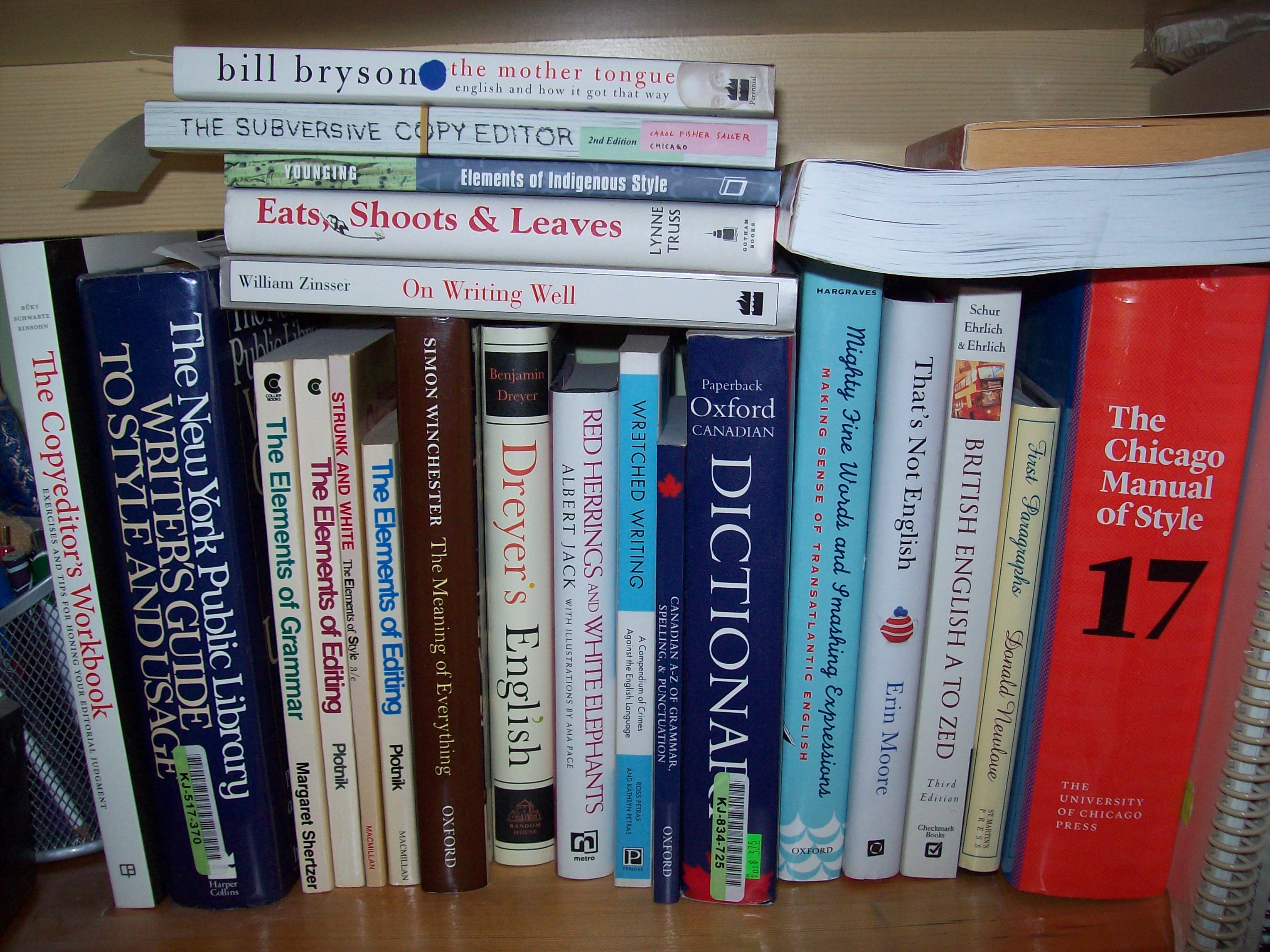
Simon Winchester’s The Meaning of Everything: The Story of the Oxford English Dictionary has given me a deeper appreciation and a better understanding of what goes into creating dictionaries. Now, when I use my copy of the Canadian Oxford Dictionary, I’m even more aware of the complexities of the English language where one word can have multiple, and often quite diverse, meanings. I find it fascinating that new words are regularly added to dictionaries, that older words can take on new meanings, and that sometimes words end up falling into disuse as society and language evolves.
Understanding language, especially for editors, is a serious business. However, I prefer books where the author takes a lighthearted but well-informed approach to the subject like in Dreyer’s English: An Utterly Correct Guide to Clarity and Style, by Benjamin Dreyer. Who knew I could laugh so hard while reading a grammar book?
I’m British-born and an anglophile, so I like reading books about British English and how it differs from the English used in other countries. That’s Not English: Britishisms, Americanisms, and What Our English Says About Us, by Erin Moore, is an informative and interesting book about how the words we use are a reflection of and a window into our history and culture. I’ve also enjoyed The Mother Tongue: English and How it Got That Way, by Bill Bryson, which is an extensive and often witty history of English.
Gregory Younging’s Elements of Indigenous Style: A Guide for Writing By and About Indigenous Peoples was an eye-opening window into a culture I’m ashamed to say I was previously fairly unfamiliar with.
For plain language, I’d highly recommend Cheryl Stephens’s Plain Language in Plain English and Martin Cutts’s Oxford Guide to Plain English.
As editors, we’re lucky that we have such a large number of books available to help us expand our skill sets, so read on, my friends, read on!
Stacey Berquist is a freelance academic and nonfiction editor and an in-house grant specialist. Her bookshelf is in Toronto.
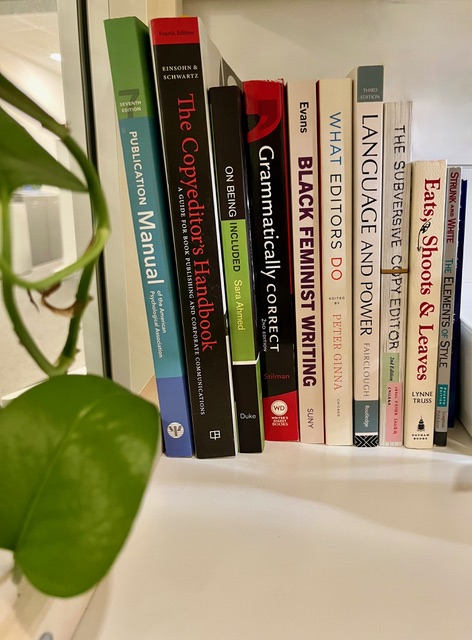
The Subversive Copy Editor: Advice from Chicago (or, How to Negotiate Good Relationships with Your Writers, Your Colleagues, and Yourself), by Carol Fisher Saller, was one of the first editing-specific books I encountered; I think it was recommended in an editing course I was taking. As someone who was raised in quite a grammatically prescriptivist family, this book helped me along the road to a more nuanced appreciation of language and language rules and a deeper reflection on my role as an editor. Saller’s voice and style also make this an enjoyable read.
On Being Included; Racism and Diversity in Institutional Life, by Sara Ahmed, is a book I first encountered in my previous life while studying political science; I have long believed that language is deeply political, and Ahmed’s book is an excellent example of that. As well as being an interesting read, I have found it very helpful for attending to the dangers of empty language, especially when I’m editing or writing for institutions.
I have only recently begun reading Black Feminist Writing: A Practical Guide to Publishing Academic Books, by Stephanie Y. Evans, but I already find it very compelling. While I am not a writer of scholarly books, I support academic faculty members who are, and I am always trying to find resources that may be helpful for them. I also try to remain current with insights and research that can inform my approach with clients as well as my own work practices.
This article was copy edited by Joy Moskovic (she/her), an editor and communications professional living in Ottawa. She recently completed the Editing Certificate Program at Simon Fraser University.

 BoldFace