
“What’s in Your Editing Workspace” peeks past editors’ bookshelves and into their workspaces. In this third instalment, we explore everything from our day-to-day stationery to furniture, hardware to sources of inspiration, and more. If you have something you’d like to share, let us know. We want to see what’s in your editing workspace.
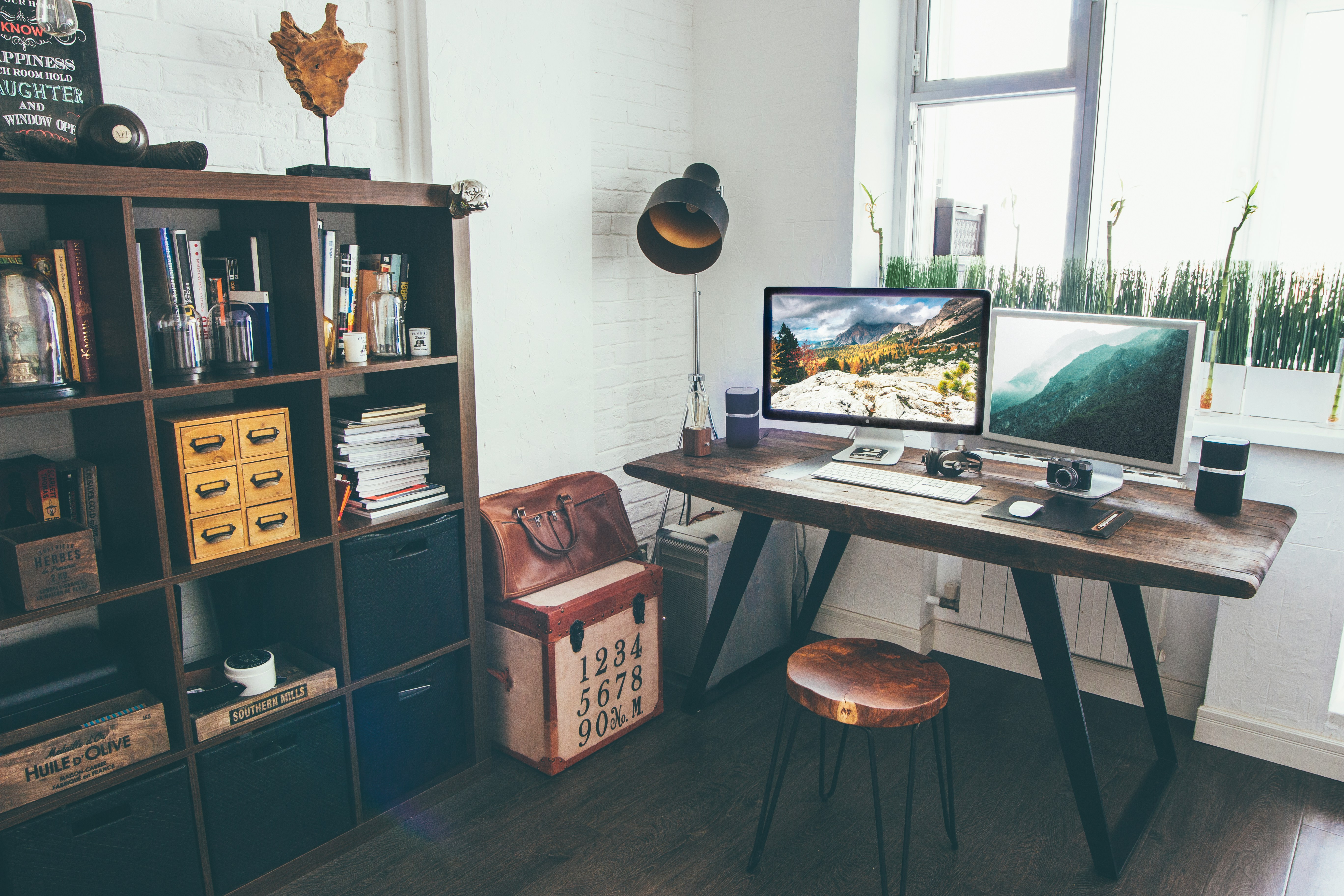
Laura van Alphen (she/her) is an academic copy editor whose workspace is in Hamilton, Ontario.
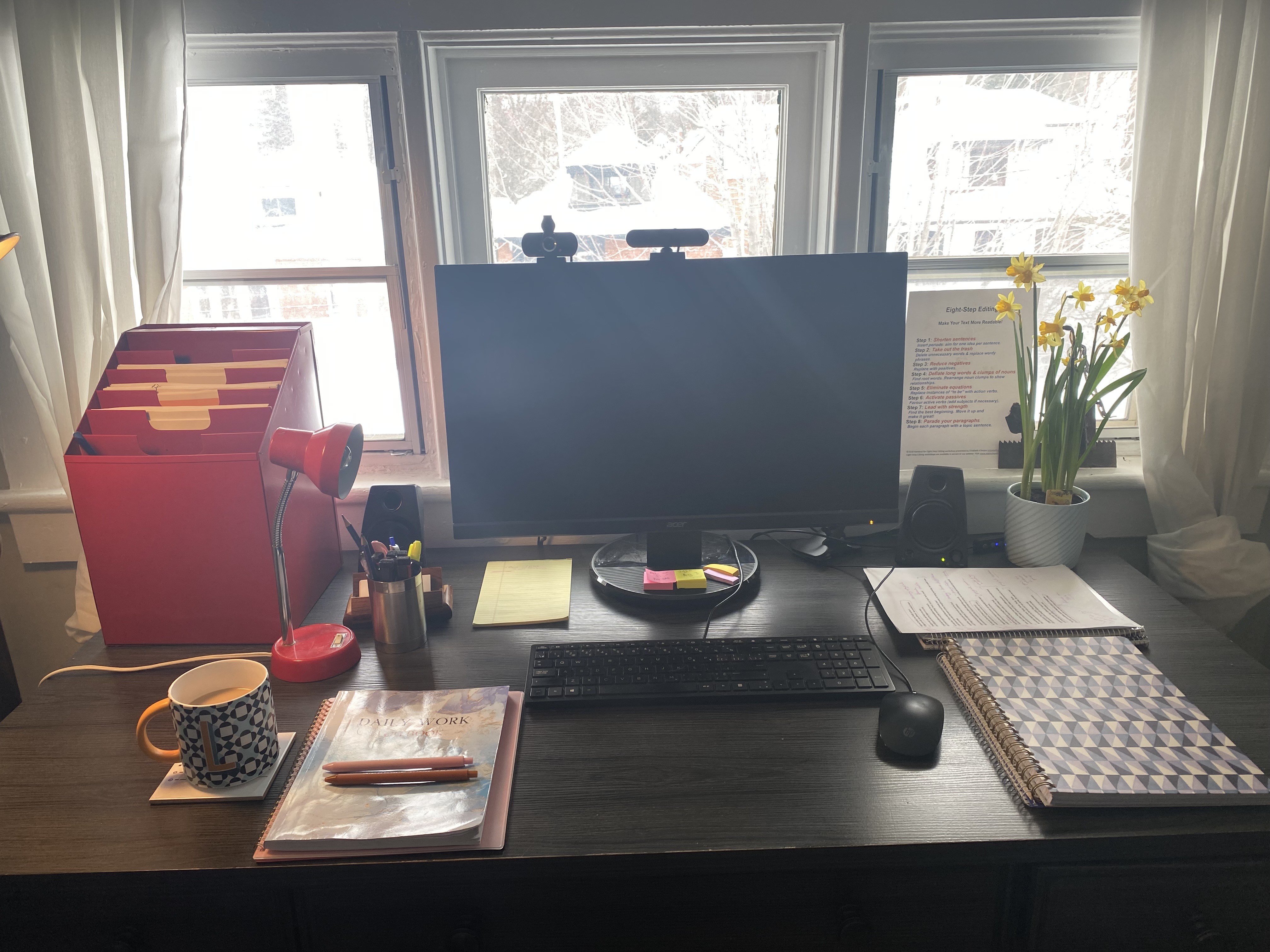
I love having my workspace on the third floor because it allows me to physically “go to work” even though I work from home. I watch the seasons pass on the maple tree outside my window; its most gorgeous season is fall, but I am eagerly awaiting that moment when the leaves open and everything outside my window is green. Until then, some daffodils.
I always have a variety of notebooks and pens at the ready, a desk lamp for any close paper reading, and my favourite mug (almost always filled with coffee). In my window, I keep a copy of the Eight-Step Editing handout from a workshop (with the same name) led by Elizabeth d’Anjou. It continues to be an invaluable resource.
A few years ago, I added a kneeling chair to my set-up, and it helps to keep my posture in check. I keep a planner and logbook on my desk; periodically, I try out different digital timers to track my workflow, but I always come back to paper.
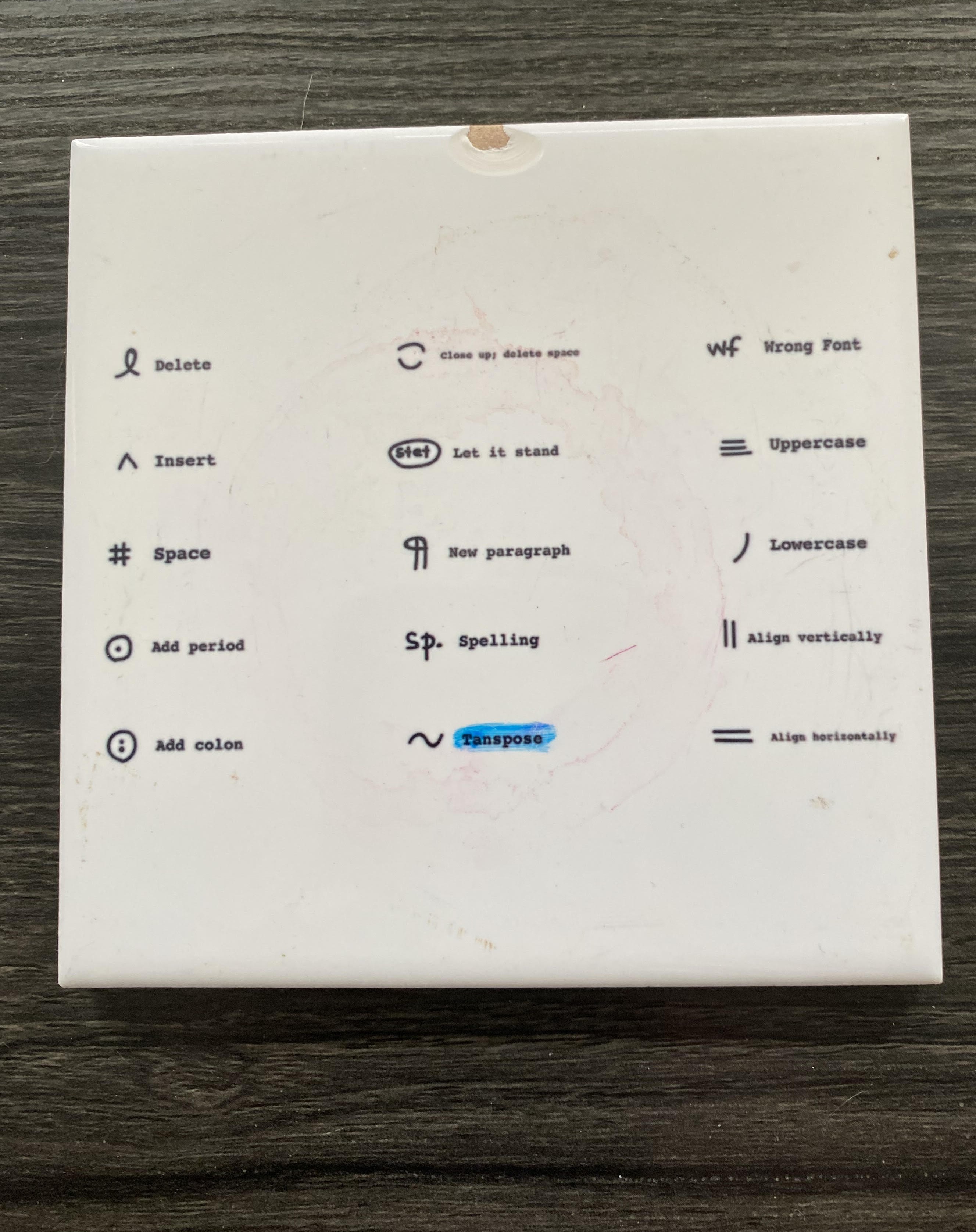
Recently, I discovered a new favourite type of pen that feels good to write with, comes in fun colours, and has Taylor Swift song lyrics on them (“borrowed” from my daughters). I am also amused every day by my coaster of proofreading symbols because it has a spelling error!
To the left of my desk, I have a bookshelf full of resources (I use APA 7 the most), my whiteboard monthly calendar, and my editing certificate from Simon Fraser University. And perhaps most important in an attic office in winter – a space heater!
Lorna Stuber is a freelance editor whose workspace is in Okotoks, Alberta.
Until a year and a half ago, I didn’t know it was possible to buy pre-punched paper for printing out documents. I like to proofread on a hard copy because my eyes catch more than they do on screen, especially when looking for typesetting errors, so I always printed out manuscripts and then put my three-hole-punch to work. The paper with pre-punched holes saves me time, and also makes for a neatly aligned manuscript that I can then put into a binder and take with me if I want to proofread in a coffee shop, library, and so on. My other proofreading tool is a FriXion clicker pen – erasable! I was required to use these in the proofreading course I took when I did my training, and I’ve been hooked on them since!
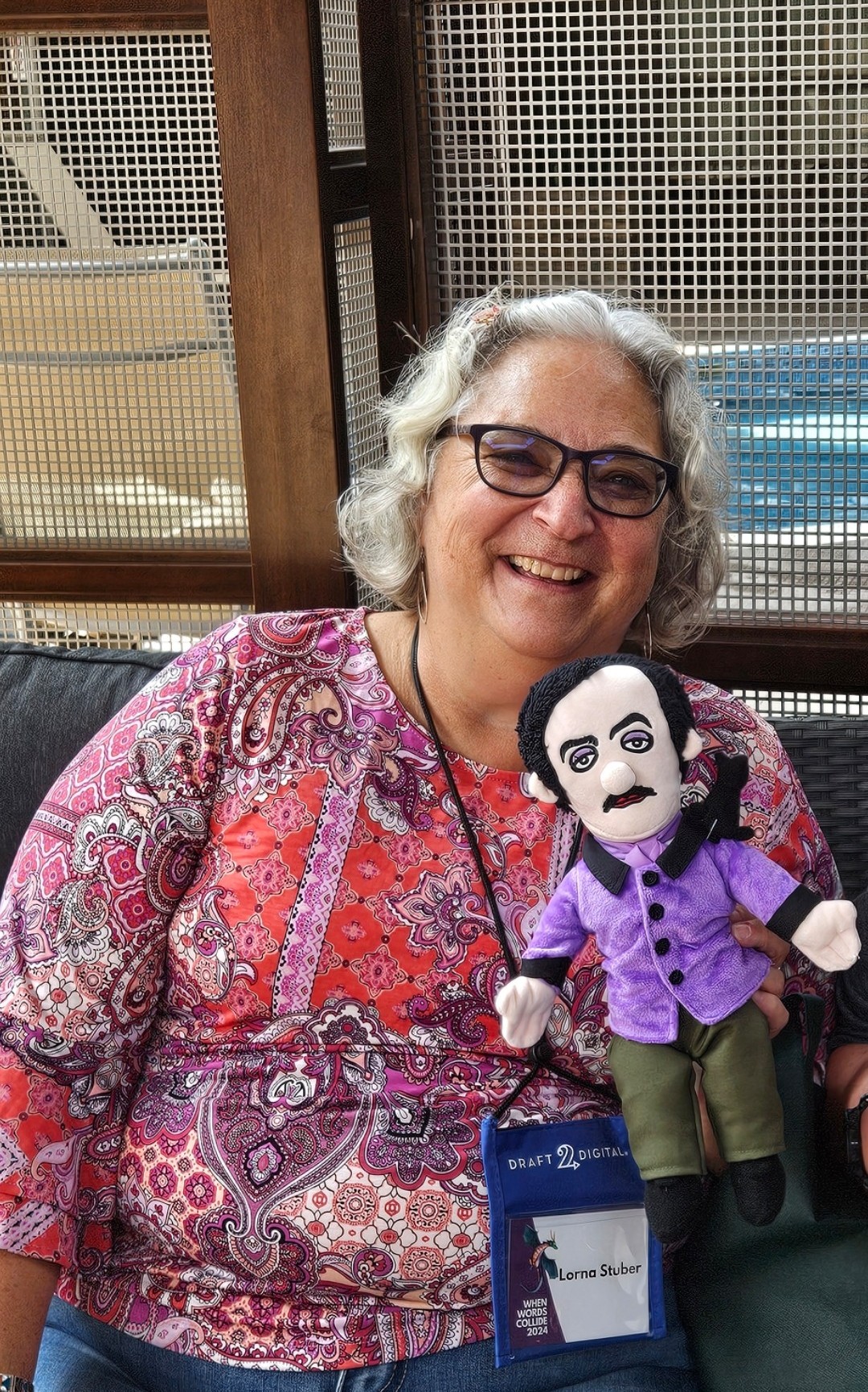
I live alone, so it’s pretty quiet in my office except for SiriusXM, which I always have playing through the computer speakers. And I have a new office assistant as of August this year – my new Edgar Allan Poe stuffy, complete with a (velcro) removable raven on his shoulder! He’s purple and soft, and I love him.🙂
Małgosia Halliop (she/her) is a freelance writer and editor whose workspace is in Toronto, Ontario.
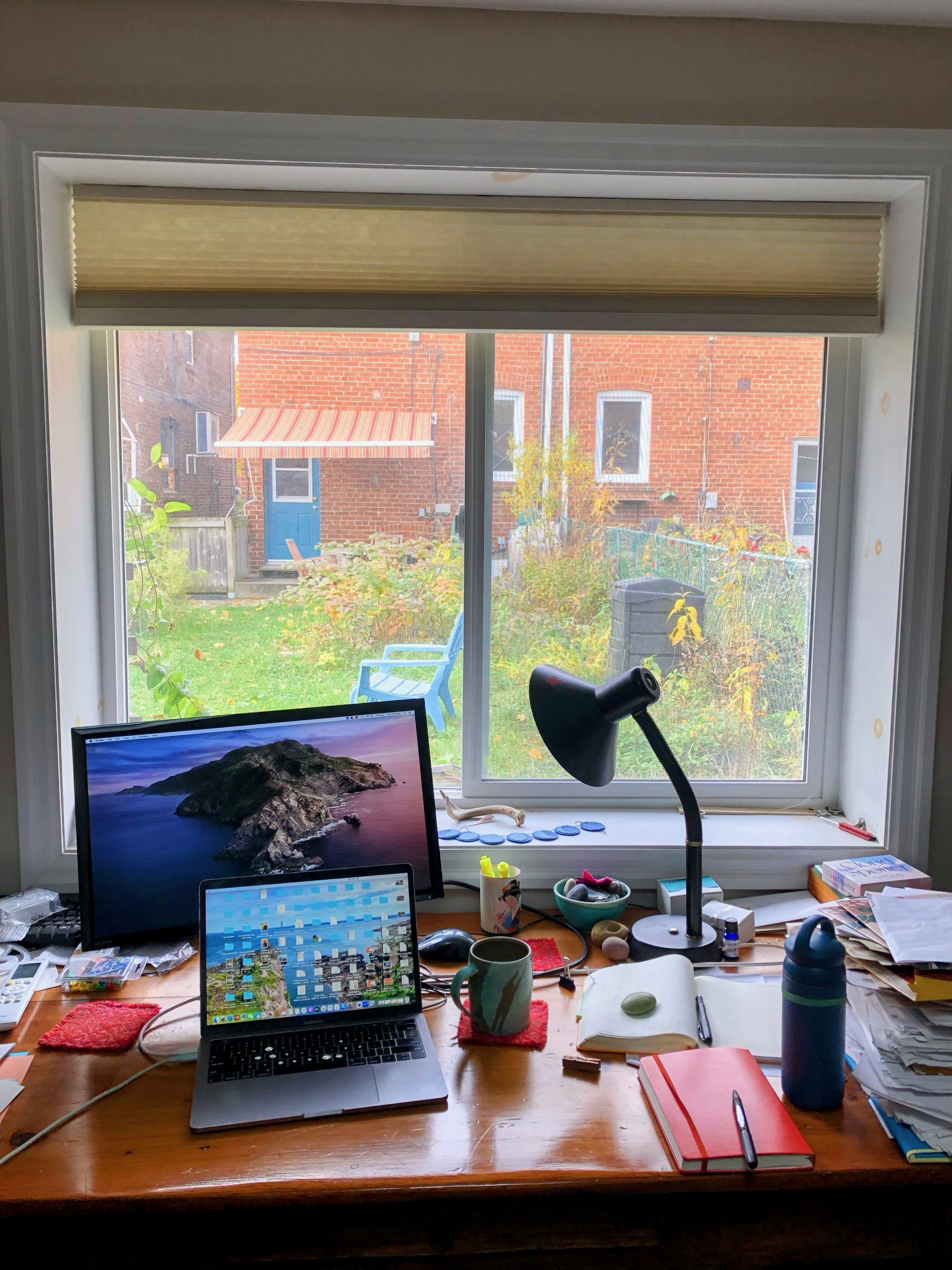
In 2022, after talking about it for many years, we converted the sturdy concrete storage shed in our backyard into a comfortable office space. This involved adding insulation, a new roof, a window, flooring, and a heat pump. The shed already had wiring. We also had a small, covered parking pad installed outside for our bikes – our main form of transportation at least three seasons of the year. When we completed the renovation, we still had our third bedroom set up as an office/crafting room/exercise space, but after a big shuffle, both our teens finally got their own room, and I moved my work out into what we now call the “studio.”
I work on a wide wooden table that came from my parents, sit on a desk chair handed down from my sister-in-law, and use a monitor on loan from my husband’s employer (my husband occasionally uses the space too!). We also have a bookshelf and a couch in the studio, and we’ve kept a large storage closet for garden tools and camping gear. The laptop I’ve had since 2020 (MacBook Pro) now has many worn-down keys, so I’m grateful for the touch-typing I learned in grade 9. I can no longer see which key is the “M” and which the “N,” nor distinguish the “S” from the “D,” but my fingers remember!
I journal and take a lot of notes by hand, and I’m particular about my handwriting tools. After much trial and error, I use Leuchtturm notebooks for journaling and creative notes – always the grid paper format. A couple of years ago, I got better at separating out practical writing like to-do lists and meeting notes from my more reflective or creative writing. Now I keep a Leuchtturm planner on my desk with lots of space for work-related notes. I’m also particular about pens. I use only Uniball™ JETSTREAM Rollerball 1.0 mm refillable pens, always in black.
The internet connection is occasionally challenging in the studio, so I sometimes need to move back into the house when the internet acts up. Then I sit on an armchair or a couch with my laptop on a lap desk.
Laura Bontje (she/her) is a freelance fiction editor and children’s book author whose workspace is in London, Ontario.
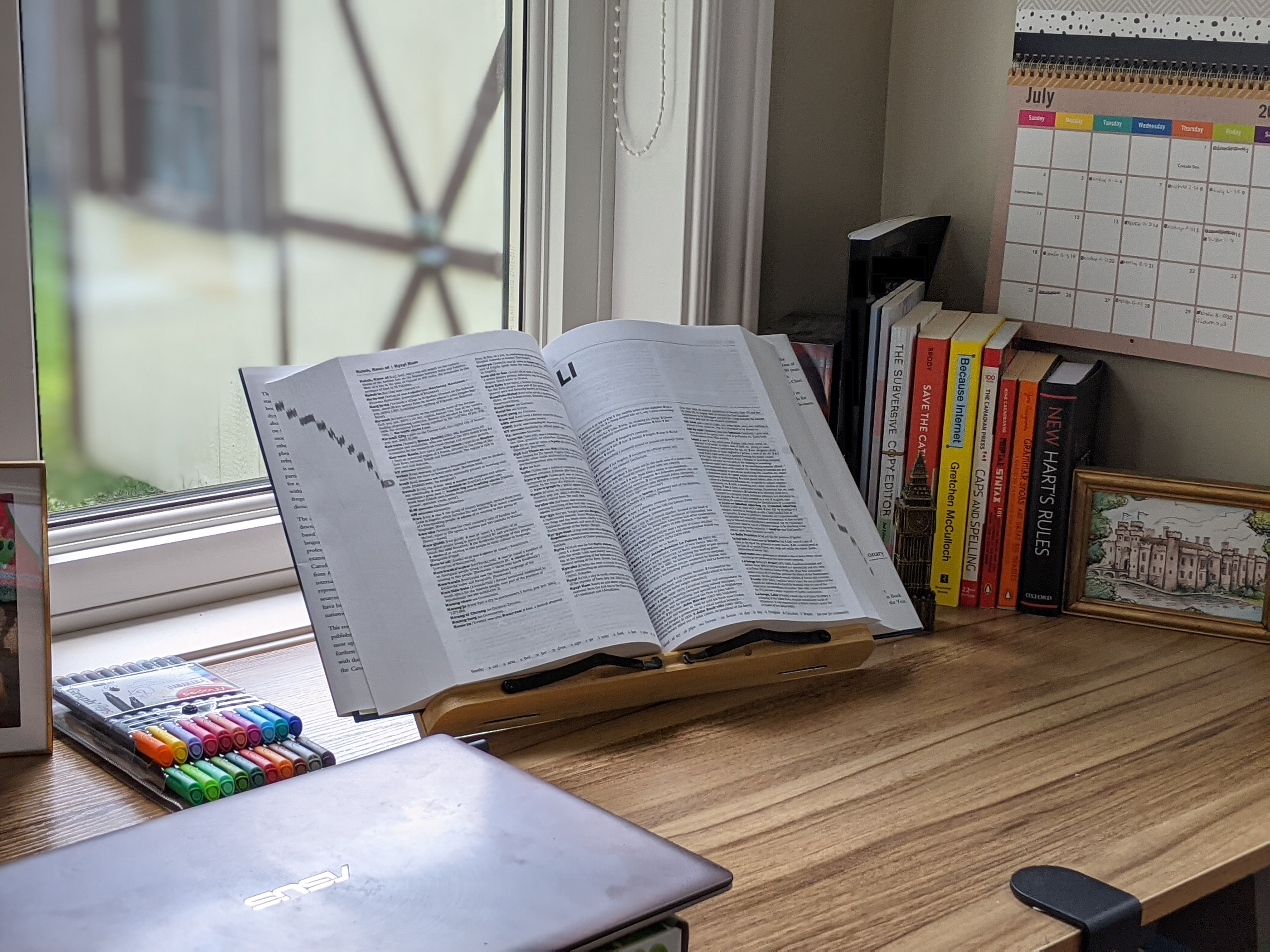
Confession: This photo is a lie. My workspace hasn’t been this tidy – or even at this desk – in a long time. So this is a tale of two workspaces. In one (the one from which I’m typing now), there’s a yellow cushion against the armrest of a grey couch, a cozy red blanket (upgraded to a sleeved blanket on the coldest days), a lap desk, and my laptop. That’s the version I use far too often, and my back would thank me if I stopped.
In the other, my materials are neatly arranged and easy to access. But my desk was messy and the cat we got last year was chewing everything, so I hid it all in plastic bins. Nimbus loves to birdwatch and sleep on the bins, so … I guess it’s his workspace now?
For practical and ergonomic reasons, I really ought to get back to the desk.
Whether my workspace is nicely organized or not, there are two things that make a big difference. First, a bookstand for the Canadian Oxford Dictionary, second edition. It’s huge and heavy, and I refer to it far more often when it’s easy to use. Second, a clip-on keyboard tray. I’m not very tall, so if my chair’s low enough for my feet to touch the ground, my arms wind up too low to type ergonomically at desk height. The tray brings my keyboard down so I can type comfortably.
This article was copy edited by Katherine Morton (MBA, BA), a certified copy editor with global clients.

 BoldFace