
by Erin Della Mattia
The work of an editor often appears mysterious to outsiders. Friends and family don’t always understand what we do. Occasionally we ourselves are surprised by other editors too, when they reveal what, exactly, they edit. Texts or products that you had never thought of as needing editing but which, once you hear it, makes total sense. Oracle decks fall into this category. I have friends who use oracle decks, and even they wonder how I edit them. So, if you’ve ever found yourself curious about editing oracle decks, or occult materials in general, join in as we gaze into the crystal ball and all will be revealed. (No crystal ball required.)

What are oracle decks?
You might be surprised to learn that contemporary oracle decks are not, primarily, used for divination or fortune telling. It is true that oracle decks, like tarot, can trace their origins back to the introduction of playing cards from the Middle East to Europe in the fourteenth century. This created a slow-burn interest in cartomancy (divination with cards) that would culminate in the spiritualism fad of the late nineteenth and early twentieth centuries. While there’s no definitive history of oracle decks, some bloggers credit French fortune teller Marie Anne Lenormand with creating the first true oracle deck during the Napoleonic era; however, the decks that bear her name were created after her death. Likely, oracle decks were created as an offshoot of tarot cards: artists and woodblock printers probably saw them as an opportunity to demonstrate their skills without being bound to any particular numerical system (which is usually required for both tarot and playing cards).
Modern oracle decks have been growing in popularity since the resurgence of alternative spiritualities in the 1960s and 70s, when the cards were used as a method of spiritual guidance. Today, they are more of a tool of self-reflection. Readers pull a card or lay a series of cards out in a spread and then interpret the combination of symbolism and keywords. This prompts readers to recognize and reflect on the patterns and cycles of their lives. The idea is that, once readers understand these patterns or cycles, they can attempt to alter them to become more aligned with their personal goals. The focus on reflection and development is part of a broader New Age trend, and it is arguably connected to our society’s preoccupation with mental health, the abstract mind, and self-improvement. Here, though, instead of an external specialist or psychoanalyst, the power of interpretation and analysis remains with the reader.
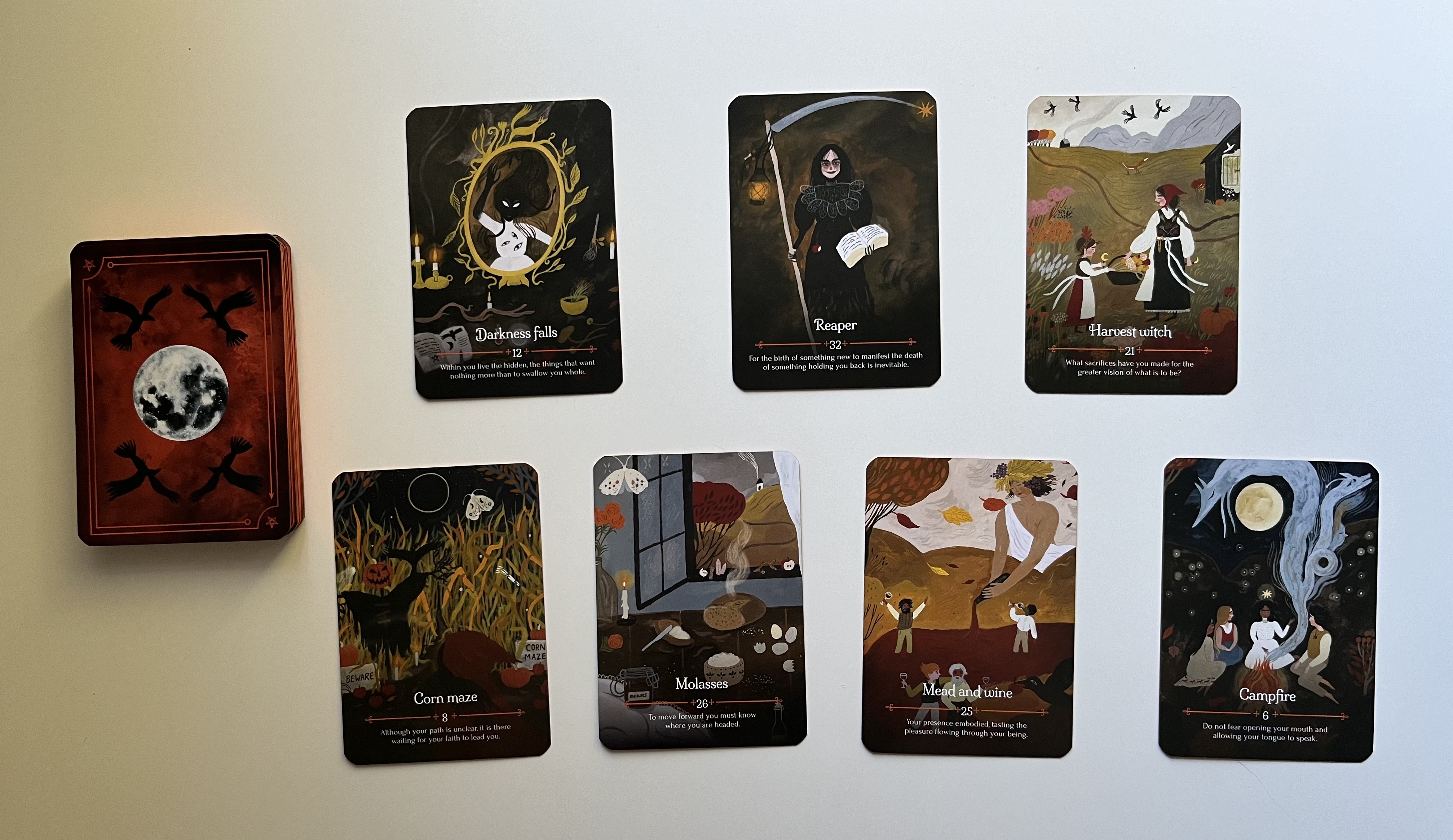
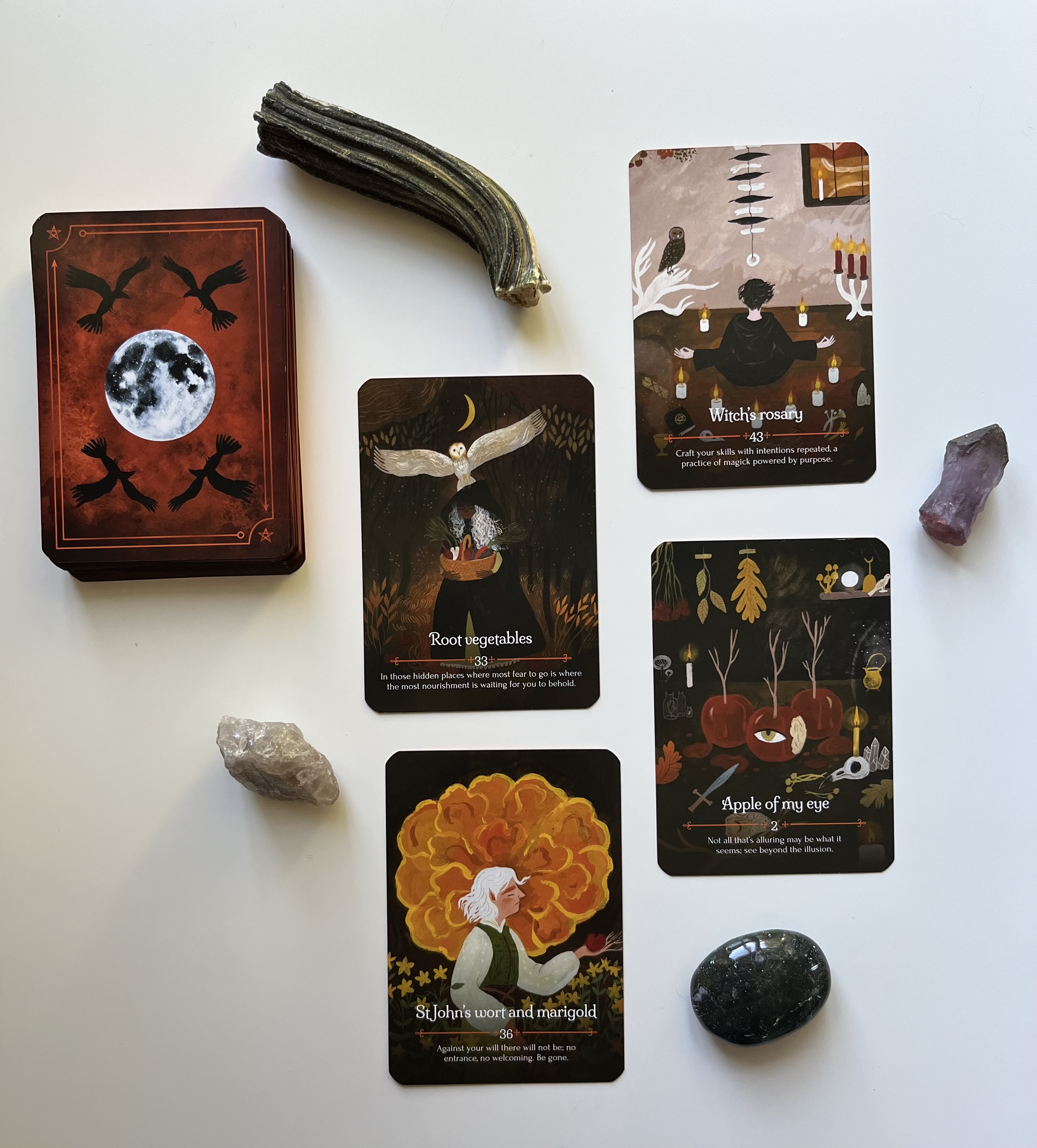
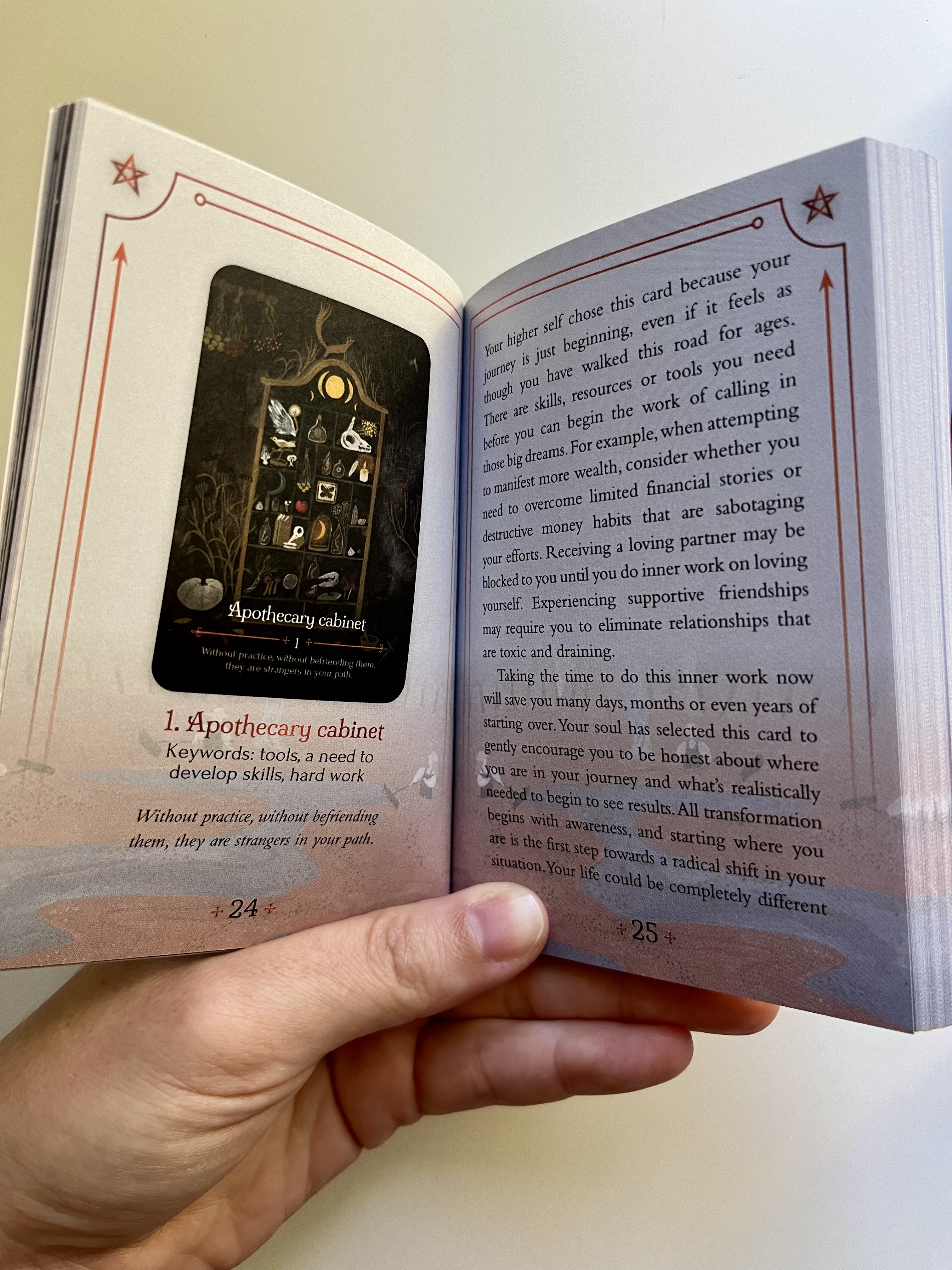
At a concrete level, oracle decks are usually crafted around a central theme: animals/nature and folklore are the most common. Each card features an image and, usually, a keyword. The decks are almost always paired with guide booklets that offer additional insights into the cards. Booklets can range from fairly simple to highly illustrated. Every card will have its own entry in the booklet, and the cards’ images are almost always reproduced in each respective entry.
What’s the difference between oracle decks and tarot decks?
Whereas contemporary tarot decks are constructed around a strict seventy-eight-card system, oracle decks don’t follow any particular system. A creator may impose a system on their deck (for example: a structure that mirrors the lunar cycle) but most don’t. The free-flowing nature of oracle decks is what makes them appealing to creators and readers alike. For creators, there’s a lot of opportunity for creativity (indeed, the only constraint is physical space); for readers, oracle decks allow for a diversity of personal interpretations that tarot, because of its structure and longer tradition, doesn’t necessarily allow.
Who are the creators?
The creators are generally active in New Age or alternative spirituality circles, usually with some kind of spiritual or nature-related social media presence. Some may be well-established within occult publishing. The vast majority of creators (and readers) are women. Sometimes the creators will be an author-artist team, and sometimes it will be one creator wearing both hats. In this case, the creator will most likely be an artist first and a writer second, meaning that there’s a good chance their guide booklet will need some solid line editing. Even if it’s not their first deck, they may feel best supported by clear explanatory comments. Creators put their hearts and souls into their work, and it can be very connected to their spirituality, so editorial respect and enthusiasm are important.
What gets edited?
Essentially, everything. The booklet (in the form of a written manuscript) and the cards (in the form of a contact sheet and/or a list of card names and keywords) are all edited. (You might think that errors can’t possibly sneak into the card names, but you’d be surprised.) The booklet, cards, and box art are also proofread.
What is the editorial workflow?
It depends on the size of the publisher. The publisher I freelance for does not have in-house editors, so I act as the lead editor on the decks, seeing everything through to final proofs. The publisher herself performs an initial developmental edit of the guide booklet before it gets sent to me for either a copy edit or a line and copy edit. There can be anywhere from two to four rounds of edits, depending on how the creator handles the revision process. Then the booklet and cards go to typesetting and design. Everything is proofread by the author, a proofreader, and myself, with the managing editor also reviewing. After the changes are inputted, I review everything again. This may seem like a lot of eyes on one fairly slim piece of writing, but a booklet’s layout and design can be very intricate, which creates a lot of opportunity for errors and inconsistencies. And considering purchase prices can go as high as $50, we want to be as close to error-free as possible.
Is prior knowledge required to edit oracle decks?
Prior knowledge of oracle decks or other New Age/occult materials isn’t totally necessary, but it does help. The tone of oracle deck booklets usually blends New Age or pagan spiritualism with self-help rhetoric: being comfortable with this tone makes it easier to confidently step into a text and make edits that match the creator’s intentions. (If occult writing makes your eyes roll, this isn’t the genre for you.)
Personally, I’d say that being able to read tarot has definitely helped me edit oracle decks. Although I am very much a novice (I wouldn’t ask anyone to pay for a reading), I have been reading tarot for about a decade. Not only has this helped me adopt the tone of oracle decks, but it has also helped me proofread the booklets. Familiarity with the layout and design of card entries allows me to take in the visual information more easily and quickly notice inconsistencies across entries. I’m paid a flat fee per deck, so being able to navigate the design in a timely manner quite literally pays off.
How did I get into editing oracle decks?
I share this to increase transparency around editing opportunities and how editors fall into professional relationships with publishers. However, other editors will likely have different experiences, so mine should not be viewed as standard. I got into editing oracle decks by sending a cold email to the publisher stating my interest and experience, with my CV attached. I discovered that more important than my tarot knowledge was my lack of experience with a Big Five publisher. Still, the managing editor invited me to do a trial copy edit with a kill fee, so that they could sever ties with me if needed. They liked my work and I became lead editor on that deck. I’ve worked with them on several other projects since then. So, if you’ve been thinking about dipping your toes into the realm of New Age editing, try reaching out to a publisher and see what happens!
Key takeaways
- Oracle decks are tools for personal reflection that combine a New Age ethos with mental wellness and self-improvement.
- Oracle decks are less structured than tarot decks, giving creators more opportunities for invention.
- Creators can be author-artist teams or solo artists, usually with a social media presence.
- Guide booklets, cards, and box art go through multiple rounds of edits and proofreads as necessary.
- Prior knowledge isn’t necessary for editing decks, but it helps.
- The layout and design of booklets can be highly detailed, so having experience with card entries can make for a speedier proofread.
- As always, the most important thing is doing good editing work.
Further Reading
- Unveiling Destiny: Illuminating the History and Impact of Oracle Cards, by Teri Prindible
- Here’s the Difference Between Tarot Cards and Oracle Decks, So You Can Deepen Your
Intuition, by Alexandra Svokos and Chelsea Jackson - Tarot Heritage, by Sherryl E. Smith
- The Only Tarot Book You’ll Ever Need, by Skye Alexander
Erin Della Mattia is a freelance editor and writer from Brampton, Ontario. With Monica Franklin, she is the co-author of the children’s nonfiction book Undaunted Ursula Franklin: Activist, Educator, Scientist (Second Story Press, 2024).
This article was copy edited by Jane Hodgkinson, a writer and editor who lives in Toronto.

 BoldFace