In this column, members of the editing community share what’s on their (physical) bookshelves and highlight a few notable titles. If you’d like to show us your bookshelf, or part of it, let us know!
Michelle Noble, freelance copy and line editor and web content writer. Her bookshelf is in Hamilton, Ontario.
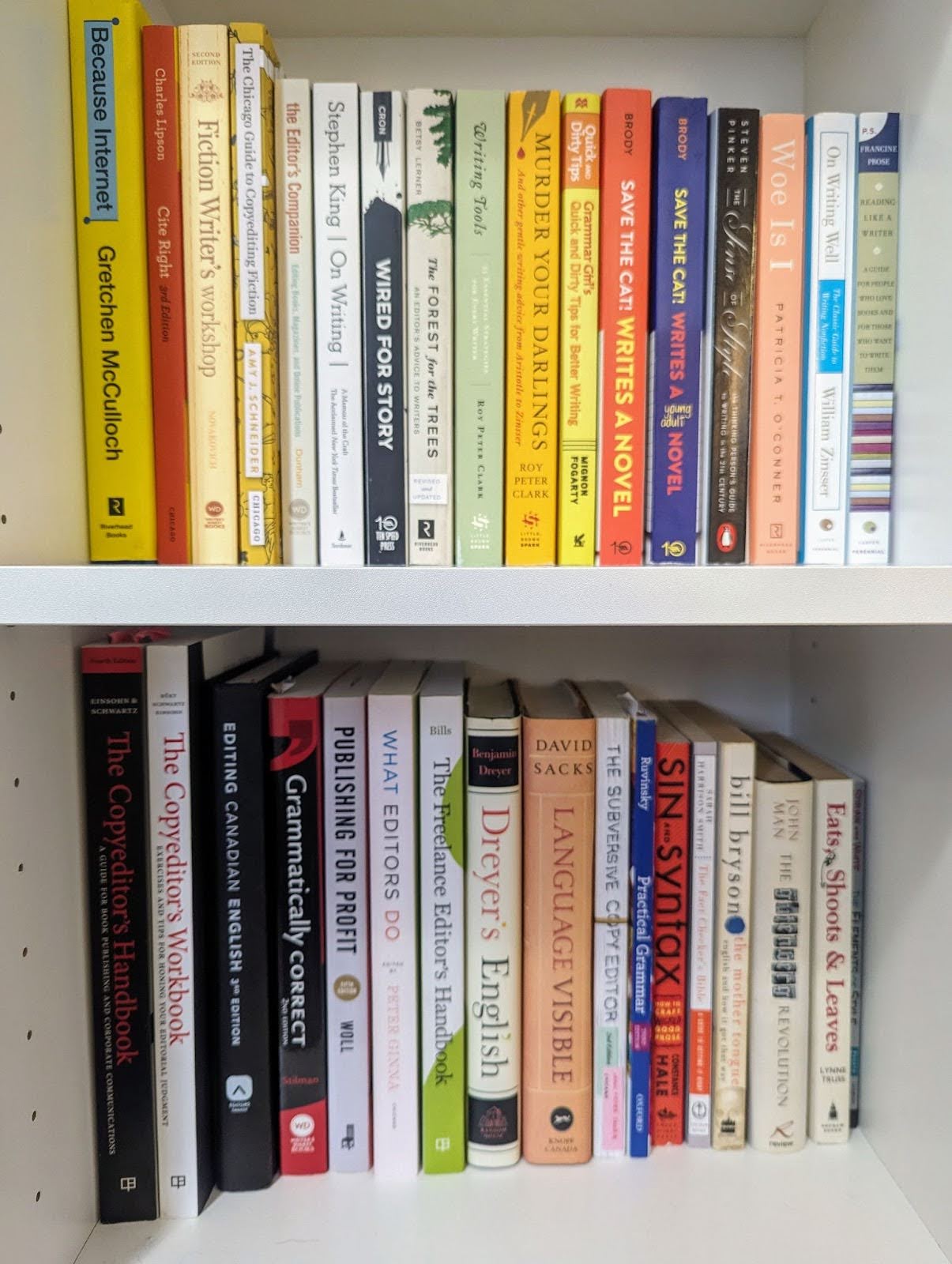
As a newer editor, my wish list of language and writing craft books is more extensive than my collection. There are, of course, the usual suspects, but I also have a few favourite titles worth noting. Wired for Story: The Writer’s Guide to Using Brain Science to Hook Readers from the Very First Sentence by Lisa Cron is a fascinating analysis of the ways writers can harness brain science to craft compelling stories, and she obviously applied her advice to her own writing because it’s a highly approachable and engaging read. I also enjoyed Because Internet: Understanding the New Rules of Language by Gretchen McCulloch. The author cautions against the pitfalls of prescriptivism in the digital age: a reminder many editors (including me) sometimes need.
When it comes to grammar, my go-to resource is Grammatically Correct: The Essential Guide to Spelling, Style, Usage, Grammar, and Punctuation by Anne Stilman. With its comprehensive index, organized and descriptive headings, and tidy reference charts, I’m able to find things quickly when my memory fails me. In contrast, Woe Is I: The Grammarphobe’s Guide to Better English in Plain English by Patricia T. O’Conner is a less technical title that has helped me develop the language I need to explain more tricky conventions to clients.
There are two titles that haven’t landed on my bookshelf (yet), but I’m eagerly awaiting their arrival. The Chicago Guide for Freelance Editors: How to Take Care of Your Business, Your Clients, and Yourself from Start-Up to Sustainability by Erin Brenner will no doubt be a vital resource as I continue to work on growing a sustainable freelance editing business. My second preorder is The Conscious Style Guide: A Flexible Approach to Language That Includes, Respects, and Empowers by Karen Yin. An extension of her popular website, I believe Yin’s book will quickly earn a coveted spot on the bookshelves of editors who are seeking a thoughtful approach to respectful and inclusive language choices.
Kay Pettigrew (she/her), editor, writer, and musician with a diverse background in non-profits, academia, and hospitality. Her bookshelf is in Montreal, Quebec.
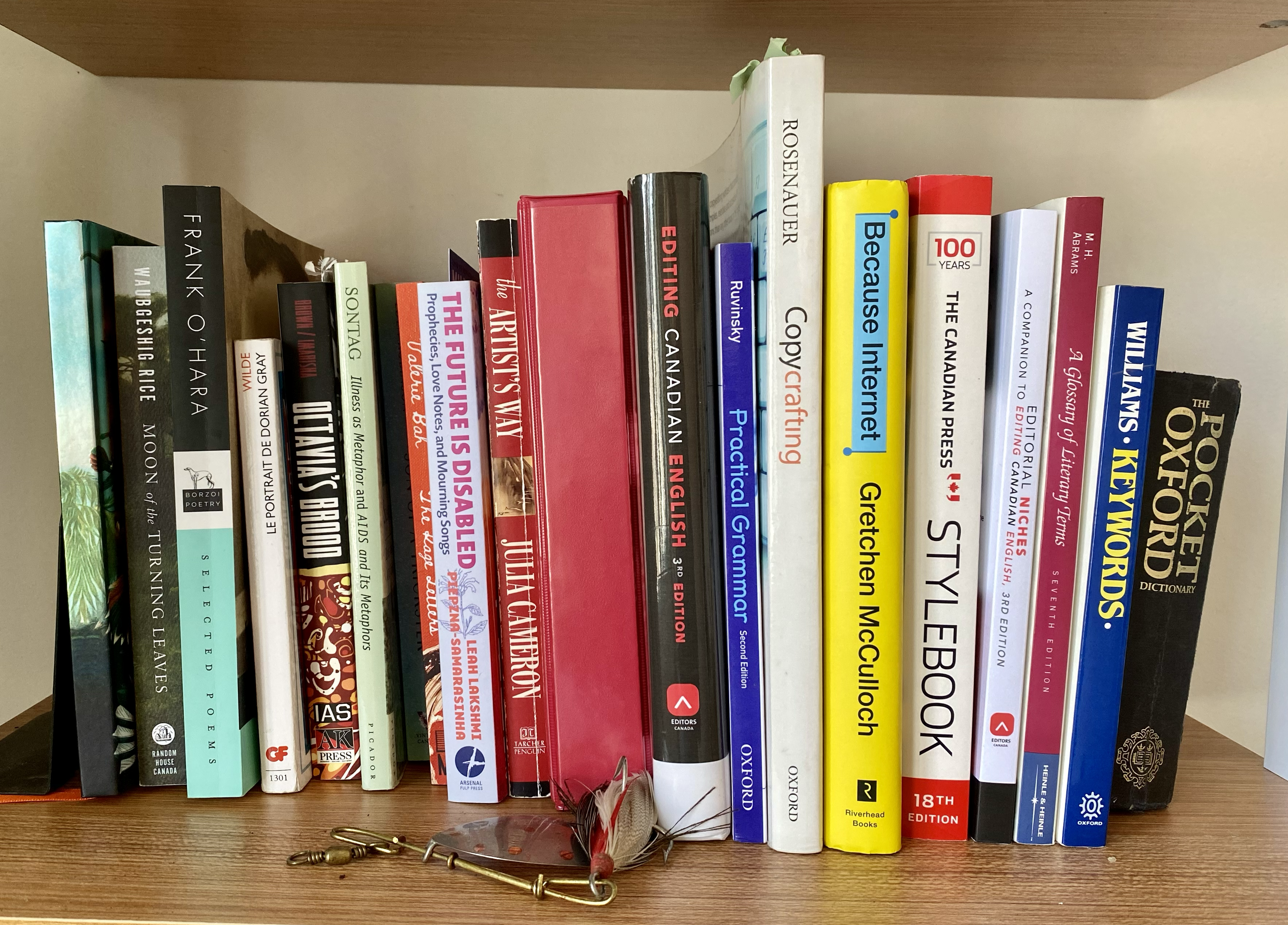
What’s on my bookshelf is a little more than what’s pictured in this curated photo, a tiny but mighty section I like to think of as my Editing Collection.
The Artist’s Way by Julia Cameron is not technically an editing book, but a life-altering reference with a (deserved) cult following. A 12-week course in recovering your creativity, Cameron’s accessible text extols the following guiding principles: write every day, and seek out novelty in the form of regular “artist’s dates.” The book is divided into weekly themes that help to untangle one’s relationship to creativity from things like making money and consuming media. It is spiritual without being too “woo” or dogmatic. Gifted to me by a friend and I’ve passed it around to many others since.
A Glossary of Literary Terms (7th ed.) by M.H. Abrams is perhaps the only assigned text from my first round of undergrad that I still reference. Each entry includes an easy-to-understand definition of the term, helpful examples from familiar texts, and suggestions for further reading. An indispensable reference for any editor who works with fiction (hopefully me, one day!).
I wish I took more notes while reading Because Internet: Understanding the New Rules of Language by Gretchen McCulloch because it made me laugh so much. It’s also extremely informative and well-researched. McCulloch’s explanation of the different types of Internet People should be mandatory reading for anyone flummoxed by intergenerational miscommunications over text. It’s also pleasantly yellow! I hope that soon there will be a 2.0 of this book that incorporates a timely discussion of AI.
The Pocket Oxford Dictionary is worth a special mention. I know it’s canonical, and I know this one is outdated, but I love this little volume with all my heart. The jacket is nearly torn off. There is a big scribble inside the front cover. It is the most used, most cherished book I own. My mom was a typesetter working at a company in Toronto in the 70s and this was one of her reference books. I think she passed it along to me when I went off to university, but it’s entirely possible that I borrowed it and never gave it back. I distinctly remember being told to “look it up” any time I didn’t know what a word meant as a kid. It drove me nuts then, but hey, look at me now!
Ambrose Li, copy editor for Studio magazine who pretends to also freelance. His bookshelf is in Toronto.

Writing about my bookshelf gave me the motivation I needed to reorganize it. Books related to editing turned out to take up only about a single shelf.
Besides the usual suspects, How to Write about Contemporary Art by Gilda Williams is not really a book on editing but can be useful if you need to deal with visual art. Next is Popular Lyric Writing: 10 Steps to Effective Storytelling by Andrea Stolpe, which explains how contemporary lyrics work (for example, how rhyming in lyrics might not work the way we expect it to). I’m embarrassed to say, however, that although I’ve used Williams’s book and finished Stolpe’s, I’ve read none of the other similar books on my shelf, even though I got them before the pandemic.
Being bilingual, once in a blue moon I might need to deal with my “other language.” (Chinese is not a single unified language, thus the scare quotes. People who share my culture don’t speak Mandarin but are expected to write in it. This written language, which we learn in school and by Western standards is a second language, has no native speakers but is still a distinct regional variant.) Two books that I sometimes use are Biblical and Theological Dictionary of Christianity, edited by Lung-Kwong Lo et al. (note that this book addresses only half of the problem: in the Chinese languages, Catholicism and Protestantism often use completely different words. This is a Protestant reference) and Communication in Chinese: On Writing. I also have some fragile old books from my parents, typeset in the traditional direction, vertically from right to left.
A few that are only tangentially related are Le Ramat de la typographie by Aurel Ramat and Anne-Marie Benoit, and The Elements of Typographic Style by Robert Bringhurst. These talk about what we might call formatting from the typesetter’s point of view so they can be useful for inoculating us against certain dogmatic views about what’s right or wrong. I also believe it’s useful to have at least a basic understanding of how things like punctuation and capitalization work in French.
This article was copy edited by Joyce Chung (she/her, they/them), a copy editor and technical editor in Vancouver, British Columbia.

 BoldFace